La Buitrera: The Lunar Cliff Where Condors Sleep
A landscape you didn't see coming
Nobody warns you before you get to La Buitrera. You leave behind Bariloche's lake views and lenga beech forests, bounce along a dirt road for twenty minutes, and then the steppe opens up — wide, dry, almost empty. The coirón grass stretches to the horizon. And then, rising out of that emptiness without apology, the rocks appear.
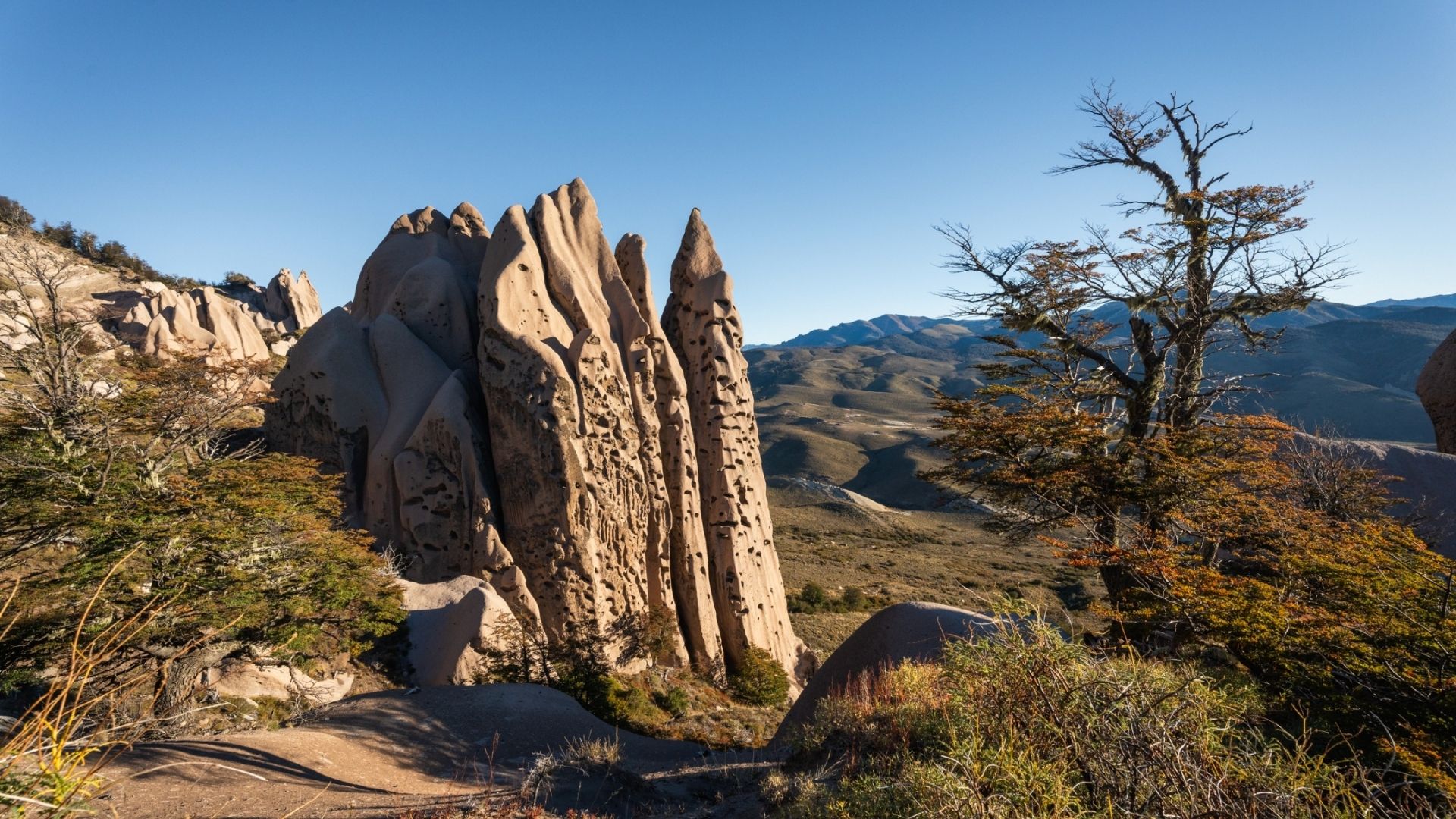
Tuff formations shaped by millions of years of wind and water — cones, mushrooms, cliff faces riddled with dark hollows that look like half-open eyes. The place feels extraterrestrial. Not the classic grandeur of the Andes, but something stranger and more intimate: a beauty that's hard to explain and even harder to forget.
The first thing you do when you arrive at Estancia La Lucha is say hello to Kela Crespo. That's not optional — it's just the right thing to do. And it's also where the real experience begins.
Getting there
La Buitrera sits in the Ñirihuau Arriba area, between 20 and 26 km south of Bariloche. By car, take Calle Esandi from the city center heading south. At the 15 km mark, cross a narrow pipe bridge over the Ñirihuau river, bear left, pass a rural school, then turn right. From there, follow the gravel road to the estancia gate. Download your map before leaving — there's no cell signal on the way.
Access runs through the Crespo family's property. At the gate, Kela takes down your details, charges a small entrance fee, and walks you through the route and key landmarks. No apps, no booking platforms — just a handshake and a conversation. You can give her a heads-up at +54 294 4597230 or find "Caminatas La Lucha – Cerro Las Buitreras" on Facebook.
No car? There's a private 4×4 transfer from Bariloche, and several local agencies run guided excursions with pickup from central accommodation.
The hike
The trail starts at the estancia with a gentle slope that lulls you into a false sense of ease. Coirón, patches of ñire and retamo mark the first stretch. Painted stakes guide the way, but the terrain is open — stay attentive. The steppe in spring carries a thick silence that feels deliberate.
The Mushroom Rocks
Halfway up, before you reach the main cliffs, the first formations appear: cones and stone mushrooms shaped by millennia of erosion. Think of these as the appetizer. Stop here before pushing on — the Ñirihuau valley is already starting to unfold below you.
The Cave of Life
It doesn't appear on any official map. Hikers named it years ago after the cave's main cavity, which has an unmistakably womb-like shape. Between the cliff faces there's a large hollow that draws people inside and reframes the entire scale of the rock. It's one of those spots where everyone goes quiet without being asked.
The Cliffs and the Condor Roost
This is what defines La Buitrera. The 100-meter cliff faces are pocked with natural cavities that serve as dormitories for Andean condors. On good days — ideally with moderate wind, early morning — you'll see five to fifteen condors riding thermals directly overhead. Bring binoculars to spot the red caruncle on the adult males. On exceptional days, over a hundred birds have been recorded on these walls at once.
"Look in any direction and you've got a painting. What I remember most from that day is a feeling of pure happiness. A place this big, this raw, mostly to myself."
From the summit or the southern ridge, the views spread out over Lago Nahuel Huapi, Cerro Blanco, Ñireco, and Challhuaco. Patagonia without the forest filter — exposed, enormous, completely real.
What nobody tells you
The hill is called "La Buitrera" — the vulture roost. But there have never been vultures here.
A decades-old confusion between the Andean condor (Vultur gryphus) and the European vulture stuck, and the name never changed. The locals know it, they'll tell you with a wry smile, and they've made peace with it. The story goes further: the condors don't actually nest here at all. Their real nests are 50 kilometers away, in Mallín Manzano or the volcanic crevices of Valle Encantado. La Buitrera is just their overnight stop — their hotel between long days of soaring.
One more thing nobody connects to a hiking trail: the Ñirihuau valley had oil discovered in it in the 1930s. The wells were abandoned, but the geological record is still there, buried under the coirón grass.
As for the Crespo family — they're not just "the estancia people." Kela's great-grandfather arrived from Carmen de Patagones in an ox cart. Her grandfather was born mid-journey, on the Somuncurá plateau. And Benito Crespo, a direct descendant, became Bariloche's first ever mayor. There's a street in the city named after him. La Buitrera has, literally, founding family history.
Practical info
| Item | Detail | |---|---| | Distance | 9.5 – 10 km round trip | | Elevation gain | +600 m | | Total time | 4 to 5.5 hours (pace-dependent) | | Difficulty | Moderate | | Best season | September – May (best: Oct, Nov, Mar, Apr) | | Minimum age | 7 years | | What to bring | Water (min. 1.5 L), snacks, sunscreen, hat, layers, hiking shoes or boots | | Leave behind | Drones (they disturb the condors) | | Cell signal | None on the route |
How to plan it
Self-guided: Drive out, download the map beforehand, call Kela in advance, pay the entry fee at the estancia (approx. ARS 5,000–8,000 per person — confirm with the family). No guide required, but the open terrain demands attention.
With transfer: Private 4×4 from Bariloche. Contact Ciriaco at +2944714027.
With a guided tour: Several Bariloche agencies offer the full package — transport, certified mountain guide, and medical coverage. Tours typically run mornings from November to April, lasting 5–6 hours total.
Timing: Leave Bariloche before 8:00 AM to catch the morning light on the rock faces and avoid midday heat on the exposed steppe.
When you get back down, Kela has fresh tortas fritas and mate waiting at the estancia. That's not a marketing line — it's just what happens. It's the ending this hike deserves.
La Buitrera isn't the longest or highest trek in the region. But it has something most trails don't: the feeling that you've been somewhere not quite fully discovered. If the wind cooperates and the condors are working the thermals above the cliffs, nothing else needs to be said. The place says it for you.
Did this story move you?