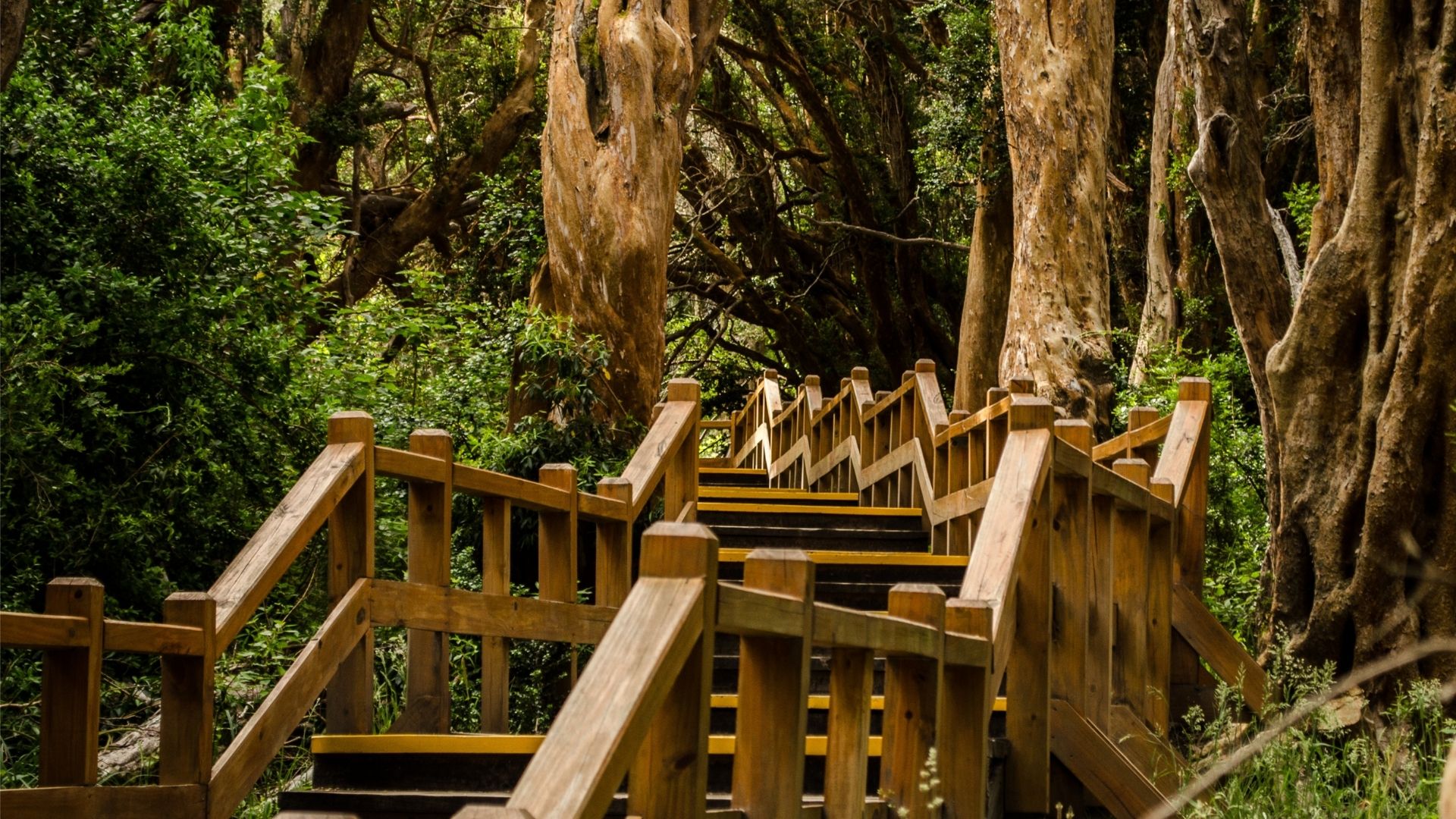
Two destinations and a journey unlike any other day in Patagonia. Lake Nahuel Huapi holds secrets and a magical forest.
The lake as a threshold
There's something that happens when the catamaran pulls away from the Puerto Pañuelo dock and the Bariloche skyline begins to fade behind you. The temperature drops ten degrees in an instant. The glacial blue of the water surrounds the vessel on all sides, and the Andes rise on the horizon as if someone had drawn them just that morning. You haven't arrived anywhere yet, and you're already somewhere else.
The excursion to Isla Victoria and the Arrayanes Forest is a journey of just over six hours where two of the world's most unique ecosystems coexist, alongside centuries of human history buried beneath the volcanic soil, a Mapuche mythology that explains why certain trees have perpetually cold bark, and an island that literally lost a letter along the way and thus earned a woman's name.
Starting point: Puerto Pañuelo
Everything begins at Puerto Pañuelo, on the Llao Llao Peninsula, 25 kilometers from the center of Bariloche. Most excursion packages include transfer from the city center (~30 min, ~25 km). The catamaran heads first to the Arrayanes Forest, then to Isla Victoria —or the reverse, depending on the operator and the time of day. The order may vary, but the experience at each place is different enough that neither one overshadows the other.
The Arrayanes Forest: the quetri and its cold bark
When the catamaran docks at the Quetrihué Peninsula and the guide signals the start of the boardwalk trail, we encounter the arrayán —or quetri, as the Mapuche people call it. It has bark the color of deep cinnamon, almost saffron, which shifts in tone with humidity and light. It is cold to the touch. Unexpectedly cold, as if it were holding something inside.
The specimens in this forest are between four hundred and six hundred years old, and what makes them unique in the world is not just their age: everywhere else on the planet, the quetri grows as a shrub. Only here, on this small thousand-hectare peninsula at the edge of Lake Nahuel Huapi, does it reach the height of a tree. Only here does it form a forest.
The name of the place, Quetrihué, says it all: quetri (arrayán) + hué (place). "Place where arrayán grows." The Mapuche people knew what was special about this land long before any explorer arrived.
The Mapuche legend tells of a young woman named Maivé who fell in love with the quetri the moment she first saw it. Her love was so deep that she became enchanted in the forest forever. They say that is why the bark is always cold: it holds that love without ever melting.
At the far end of the trail, there is a small historic wooden house with a tea room inside. Perfect for a hot chocolate before returning to the dock.
Isla Victoria: the island that lost a letter
The vessel continues on to Isla Victoria, the largest island in Lake Nahuel Huapi, with 3,700 hectares of forest, trails, and rocky coastline. The landing point is at Puerto Anchorena. Few visitors know that this island was not always called this. Its original name was Nahuel Huapi —"island of the jaguar," in the Tehuelche-Araucanian language, where nahuel means jaguar or puma and huapi means island. When the military cartographers of General Roca arrived to draw the official maps, they renamed it in honor of Benjamín Victorica. With a "c". Over time, everyday usage wore away that consonant, and the lake kept the name. Victoria.
From Puerto Anchorena, marked trails lead in fifteen minutes to Playa del Toro, a black volcanic sand beach where rock paintings made by the indigenous peoples who inhabited the area approximately seven hundred years ago have been preserved.
The nursery that shaped Patagonia
Further into the island, the trails lead to the former Vivero Nacional, today the Jardín Botánico Isla Victoria. What appears to be a walk through a mixed forest is actually one of the most extraordinary botanical archives in South America: the nursery holds 140 species from every continent and has been recognized as internationally significant by the Botanical Gardens Conservation International (BGCI).
In the 1940s, in a small wooden building in these same forests, Argentina's first School of Park Rangers was established. Young people from all provinces came here to train in this corner of the lake.
The monster that inhabits the waters
The lake has its own mythological being: El Nahuelito. A story that begins with sightings of a creature five to seven meters long. Sailing Lake Nahuel Huapi knowing all this means searching for it in the waters, hoping to catch a glimpse.
Practical information
Distance navigated: ~22 km from Puerto Pañuelo (round trip) Walking on island/forest: 2–4 km depending on trails chosen Elevation change: Minimal (flat trails) Total duration: 6–7 hours Difficulty: Low — suitable for all Season: Year-round. Autumn (Mar–May) recommended for fewer crowds and better light Minimum age: No restriction. Suitable with babies and young children What to bring: Windbreaker, comfortable footwear, warm clothing (the lake gets cold), water, snacks. Waterproof gear in winter Prohibited: Scraping or damaging the bark of the arrayanes
How to plan it
From Bariloche: Turisur and Cau Cau operate daily departures from Puerto Pañuelo. Most packages include transfer from the center of Bariloche (~30 min, ~25 km). If you have your own car, you can drive directly to Puerto Pañuelo and buy your ticket at the dock, which reduces the cost per person.
From Villa La Angostura: The least crowded option and, for those who already know Patagonia, the most recommended. From the Puerto Angostura dock you can take the lake excursion to the forest in about 4 hours with far fewer people. You can also reach the forest on foot or by bike via the 12 km trail that runs through the Quetrihué Peninsula (entry before noon is mandatory).
Guides: National Park rangers accompany the excursion and provide real information about flora, fauna, and history. This is not a self-guided visit.
Accommodation on the island: The Hostería Nacional Isla Victoria is the only accommodation on the island —reopened in 2002, it has its own history. Guests access the lake before and after the main tourist rush. A completely different experience from the day excursion.
Food
The Arrayanes Forest has a small tea room in the historic wooden house at the end of the trail — the perfect spot for a hot chocolate before returning to the boat. Prices are reportedly on the high side. The Hostería Isla Victoria has a restaurant with lunch service and direct views of the lake. The fresh trout from Lake Nahuel Huapi is the dish that makes sense to order there and nowhere else; it can be reserved through private excursions or when staying at the lodge.
In high season: In January and February, the excursion can run up to an hour longer than planned. Not recommended if you have a flight that evening.
There's something about the return to the dock, with the sun already dropping over the Andes and the water turning that leaden color that Lake Nahuel Huapi takes on at dusk, that makes you linger a little longer on deck. There's nothing to do there. Just lose yourself in the wonders of Patagonia.
Did you enjoy this article?