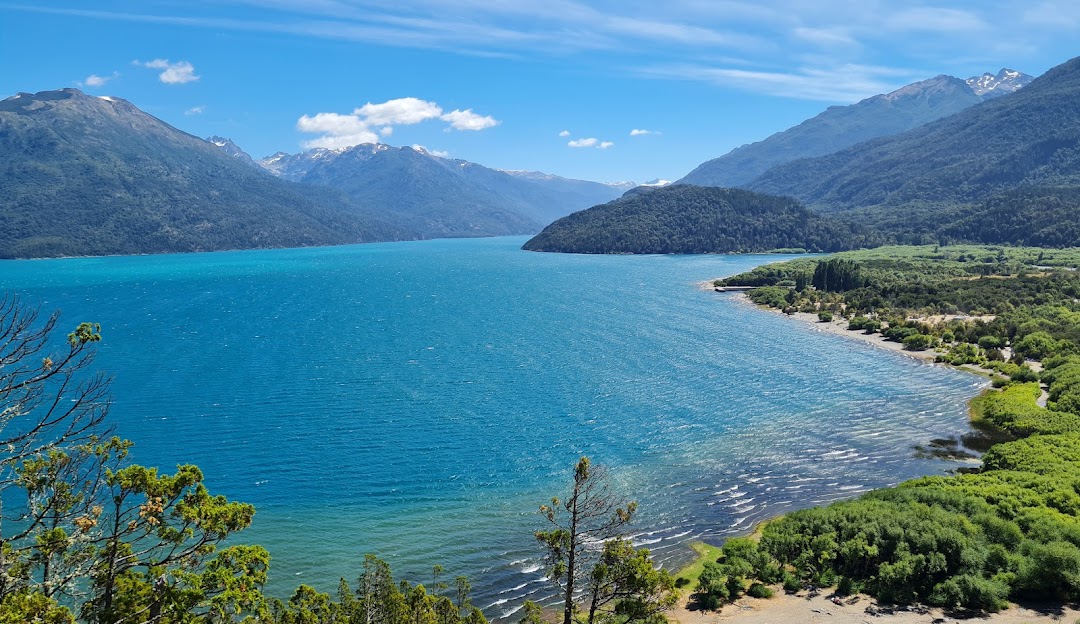
A lake born in Argentina that flows into the Pacific, a Valdivian rainforest that belongs to Chile but grows here, and a microclimate unlike anywhere else in Patagonia. Lago Puelo is the park the crowds haven't found yet.
Lago Puelo National Park: Where Patagonia Drains into the Pacific
Somewhere along the trail to the Mirador del Lago, the forest opens up and the color of the water stops you cold. It's not the electric turquoise of Torres del Paine postcards. It's something quieter — almost green, almost alive, as if the lake had absorbed the color of the coihue trees that surround it. That moment says everything about Lago Puelo National Park: a place that doesn't shout, but once it has your attention, you won't want to leave.
A Park That Shouldn't Exist Here
Lago Puelo is a geographical anomaly that biologists still celebrate. At just 200 meters above sea level — a remarkably low elevation by Andean standards — species from the Chilean Valdivian temperate rainforest thrive here unlike anywhere else in Argentina: the hazelnut tree (avellano), the tique, the ulmo, the lingue. The climate is milder than Bariloche or El Chaltén. More rainfall, less wind. Gentle winters. Generous summers.
That's why its 27,674 hectares — recognized as a UNESCO Biosphere Reserve (Andino Norpatagónica) since 2007 — shelter an unusual range of wildlife: the endangered huemul deer, the pudú (the world's smallest deer), the puma, the monito del monte (an ancient arboreal marsupial), and the chucao, the park's emblematic bird. The chucao never shows itself, but it fills the forest with a call so powerful it seems to come from every direction at once.
The turquoise color of the lake shifts with the seasons. In late summer, glacial sediment from the Turbio, Azul, and Epuyén rivers gives the water a deep, opaque intensity. In autumn and winter, it turns more translucent, closer to green. Same lake, four different versions.
And here's the fact that most visitors never learn: Lago Puelo sits in Argentina, but its water doesn't end up in the Atlantic like nearly every other Patagonian river. Through the Río Puelo, it drains west across the Andes and empties into the Reloncaví estuary in Chile. One of the only lakes in all of Argentine Patagonia where the water flows toward the Pacific.
What to Do: Activities for Every Pace
This is not a single-day park, and it's not a single-level park. There's something here for every kind of traveler.
Trekking to Cerro Currumahuida
The park's flagship trail climbs to a natural viewpoint 130 meters above the lake, with panoramic views of Lago Puelo, the Tres Picos, Cuevas and Vanguardia peaks, and the Andean spine behind them. The ascent is steep and demands real physical effort — but the payoff is worth every step. Along the way, wild murra berries and maqui grow at the trail's edge, free for the taking. The full circuit, combined with the Faldeo–El Chucao loop, crosses mixed forest of Patagonian cypress and coihue. Moderate to hard. Around 3 hours.
Pitranto Grande Trail and La Playita Viewpoint
For families with kids, older travelers, or anyone who simply wants to walk without rushing, this short circuit through flooded pitra forest is the right choice. Wooden boardwalks wind through a rare ecosystem — the pitra (Myrceugenia exsucca) grows with its roots in standing water. The views from the La Playita lookout more than justify the modest effort. Easy. About 40 minutes.
Cerro Plataforma Multi-Day Trek
For those who already know the park and want to push further: the Cerro Plataforma traverse is the real challenge. Starting from El Turbio — accessible only by boat across the lake — this multi-day route crosses isolated terrain that very few visitors ever see. Prior mountain experience and full self-sufficiency are non-negotiable.
Boat Trips on the Lake
Daily departures from the park's main sector are the only way to reach La Playita and the remote southern end of the lake. The boat crossing also offers the best perspective on the park's true scale: hanging glaciers on the Tres Picos and Vanguardia peaks, forest running all the way to the waterline, the stillness of the mountains from the center of the water.
Mountain Biking and Botanical Garden
The park has guided mountain bike circuits through the forest, suitable for families, that avoid the elevation gain of the high-altitude trails. The 16-hectare Botanical Garden — inside the park, well signposted, with species identification panels — is worth a visit even for non-hikers. Paid entry in high season.
Fishing, Camping, and Rock Art
The park has camping infrastructure (Camping Delta del Azul, with fire pits, bathrooms, and a small store) and permits sport fishing in designated areas. Rock art sites along the Río Turbio feature red geometric motifs on erratic boulders — concentric circles, zigzags, hourglass shapes dating to the late Holocene. Ask at the park office for exact locations; they're not marked on most public maps.
Food and Drink: The Taste of Many Histories
Lago Puelo's culinary identity is the result of an immigration story unlike any other in Patagonia. Chilean ranchers, Mapuche farmhands, Lebanese immigrants who crossed the steppe on foot, Ukrainian settlers who brought new agricultural techniques — they all left something in the local kitchen.
Hops cultivation arrived in the region in 1905, and that tradition became an identity. Craft beer here isn't a tourist add-on: it's part of the local economy. Cervecería Radal, a family operation committed to regional producers, brews with mountain water, local barley, comarca hops, and house yeast. Cervecería Araucana, with over two decades of history and a new facility since 2017, is another benchmark. Bandurria Cervecería pairs house-brewed beers with smoked charcuterie boards in a relaxed bodegón setting.
The Ruta 16 food strip — the road to the park — mixes cordillera gourmet cooking with Central European baking traditions and surprises like fatay, Lebanese-style empanadas that arrived with early immigrants and are now a completely natural part of any local market. The Feria Puelo Produce, open daily in the town square, sells seasonal berries, vegetables, homemade jams, and artisan spirits (guindado cherry liqueur, mistela). For something sweet, Chocolates Lago Puelo — known to locals simply as "La Chocolatería" — makes ice cream with local raspberries and hops.
Getting There and Getting Around
Lago Puelo is 132 km south of Bariloche and 165 km north of Esquel, both connected by fully paved Ruta Nacional 40. From Buenos Aires, the most practical route is to fly into Bariloche (approx. 2 hours) and drive or take a shared van south — about 90 minutes on a road that's already worth the trip.
The park entrance is at the end of Ruta Provincial 16. Short circuits start on foot from the main parking area. For remote sectors, daily boat departures are the only access.
There's also an almost unknown entry option for travelers coming from Chile: via Paso Puelo, crossing the Reloncaví estuary and heading upriver. It's the same route Juan Fernández took in 1621, when he came searching for the legendary City of the Caesars and found the lake instead. Not a practical primary option — but a fact that changes how you see the place.
Tips for Travelers Who Know Patagonia
The main mistake at Lago Puelo is treating it like an intense trekking destination. This is not El Chaltén. The park rewards slow travelers: the ones who stop to hear the chucao before seeing it, who wait at the viewpoint until the light shifts, who ask at the market which season's raspberries they're eating.
Timing matters in unexpected ways. Summer (December–February) brings more visitors, more daylight, and peak activity — it's also when glacial sediment makes the turquoise most intense. March and April bring Patagonian autumn colors, fewer people, and ripe wild fruit along the trails.
The microclimate will surprise you. Unlike most Andean parks, Lago Puelo has very little wind. Rainy days aren't wasted days: the wet forest has its own atmosphere, the short trails are walkable in a rain jacket, and the colors deepen.
Snow is a short drive away. For winter visitors or those wanting to combine the trip with skiing or snowboarding, the closest ski resort is Cerro Perito Moreno, about 30 km from Lago Puelo and 25 km from El Bolsón. It offers 16 runs across 23 km of skiable terrain, a chairlift, a ski school, and some of the most affordable lift passes in all of Patagonia — with runs through lenga beech forest and views across the comarca.
A Festival Born from Environmental Awareness
Every February, Lago Puelo hosts the Provincial Festival of the Forest and Its Environment (Fiesta Provincial del Bosque y su Entorno), which has been running since 1992. It didn't start as a tourism event — it began as a community initiative to raise awareness about the protection of native forests, driven by a local resident named Hilda Rin, whose name the town's central amphitheater now bears. Over the years it grew: invited musicians, craft and artisan markets, food stalls, a folklore festival, and the traditional Backpacker's Dance. It's one of the few cultural events in Patagonia that has kept its original community spirit intact.
Planning Your Visit
The park is open year-round, though some trails may close in winter due to weather. There's a per-person entrance fee, with discounts for comarca residents. The Camping Delta del Azul recommends advance booking in high season. For harder routes and boat access to remote sectors, check in with the park office on arrival.
El Bolsón, 19 km away, has everything for logistics: supermarkets, ATMs, pharmacy, gear shops. Lago Puelo village — right at the park entrance — has enough restaurants, accommodation, and shops for a multi-day stay without needing to go further.
Come in February and you're in time for the forest festival. Come in April and you're in time for the colors. Come any other time and you're in time anyway — this is a park without a single definitive version.
¿Te gustó este artículo?